
Collaborative Robots Gas-Shielded Welding: Applications and Innovations
Time:
2025-04-11 10:04


The integration of collaborative robots (cobots) into industrial welding processes, particularly gas-shielded welding, has marked a transformative shift in manufacturing. As industries face challenges such as labor shortages, rising quality demands, and the need for flexible production, cobots are emerging as a cornerstone of automation. This article explores the latest advancements, applications, and trends in cobot-assisted gas-shielded welding, drawing insights from real-world implementations and technological breakthroughs.
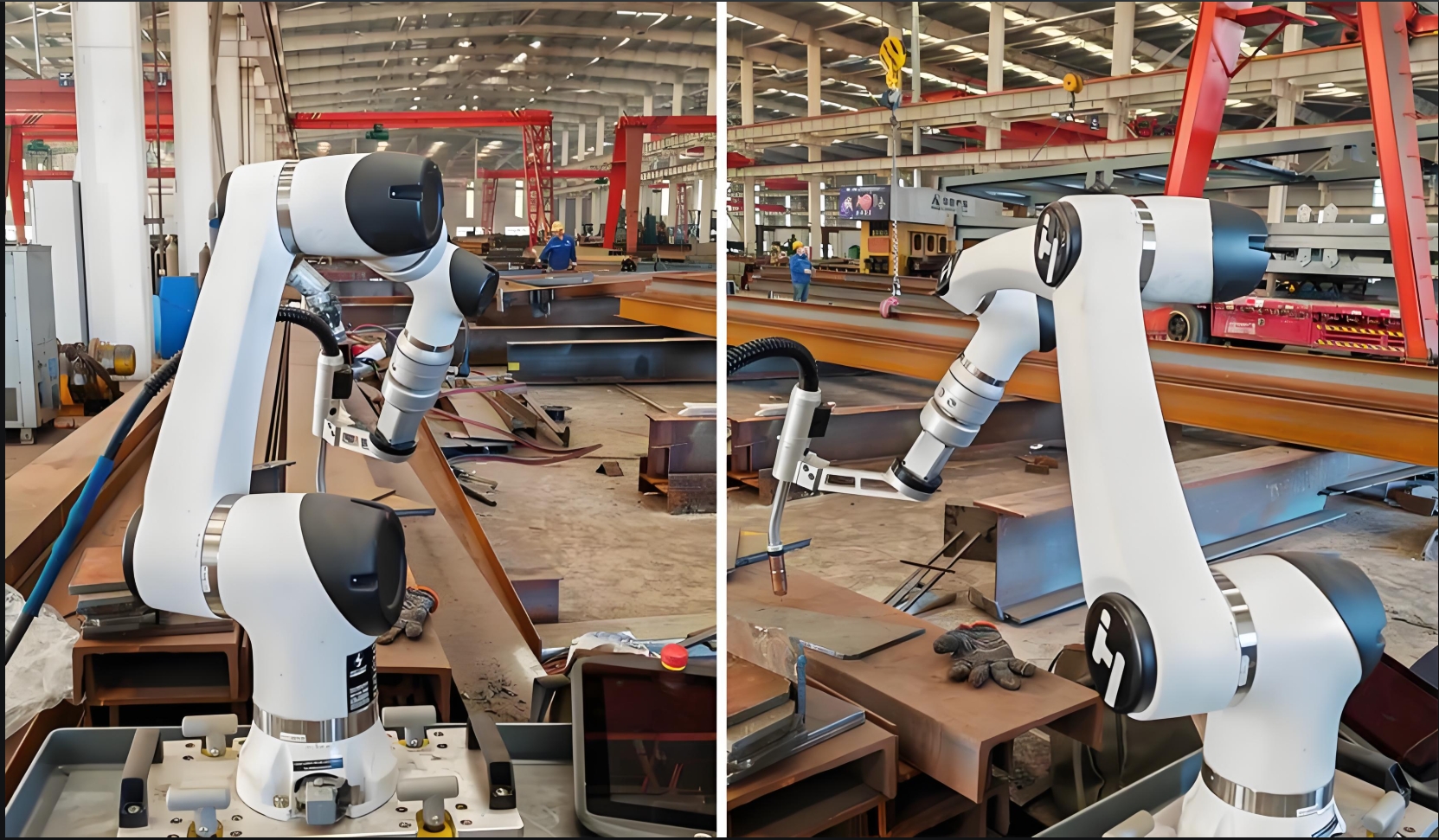
1. Technical Advantages of Cobots in Gas-Shielded Welding
Collaborative robots excel in gas-shielded welding due to their unique blend of precision, safety, and adaptability:
- Enhanced Safety: Equipped with collision detection and force-limiting mechanisms, cobots operate safely alongside human workers. For instance, DaZu Robotics’ welding cobots automatically halt or slow down upon detecting human proximity, minimizing workplace hazards.
- High Flexibility: Compact designs enable cobots to navigate confined spaces, such as ship cabins or pressure vessel interiors. DaZu’s cobots, for example, operate in spaces as small as 0.216 m², addressing challenges in shipbuilding and heavy machinery.
- Precision and Consistency: With repeatability as low as ±0.02 mm, cobots ensure uniform weld quality. FA Robotics’ systems achieve this through real-time laser vision tracking, correcting deviations during welding.
- Ease of Use: Intuitive programming interfaces, such as drag-and-teach or natural language controls, democratize cobot operation. CLOOS’s welding stations allow even novice workers to program complex tasks within minutes.
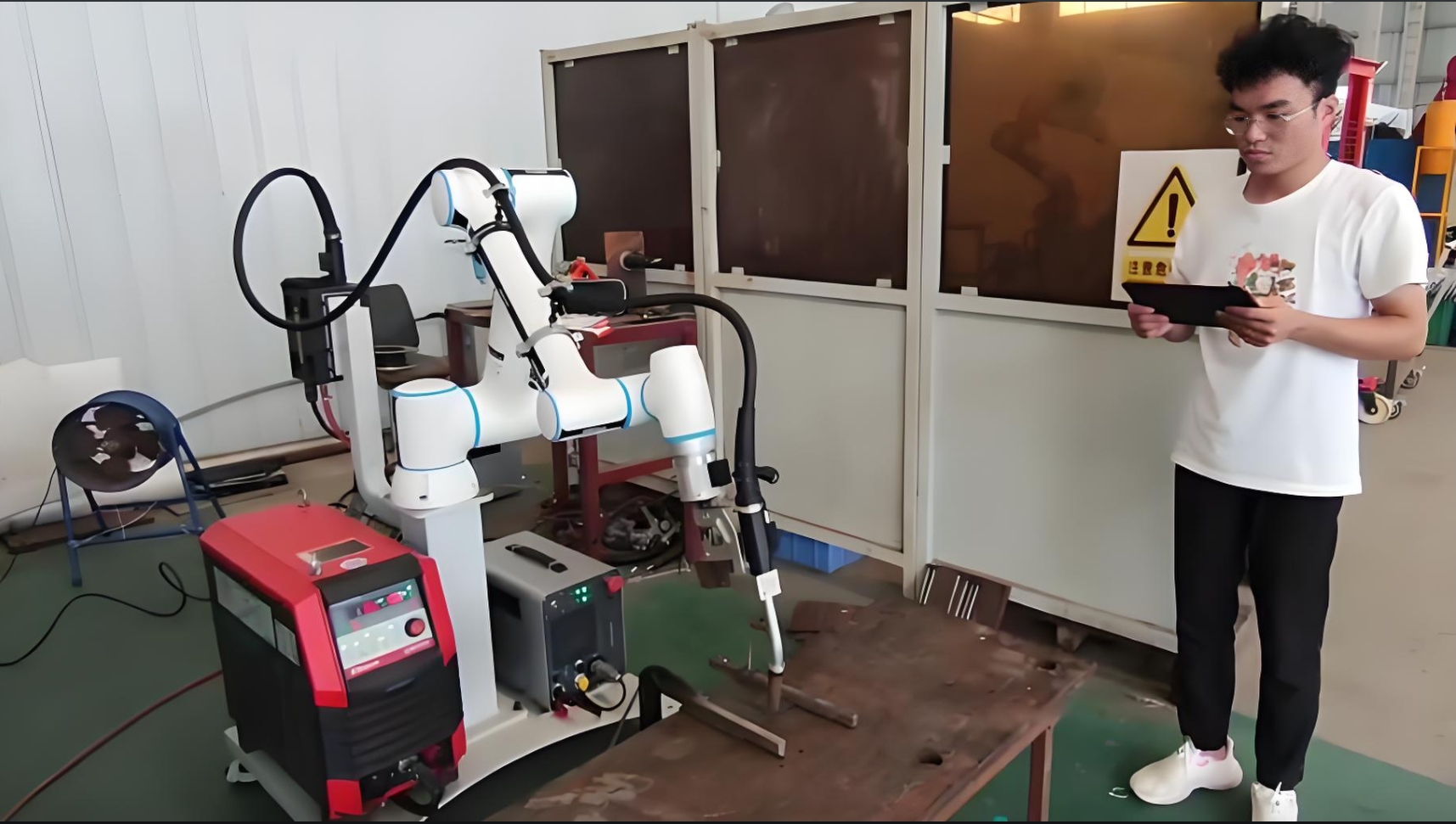
2. Key Application Scenarios
Automotive and Heavy Machinery
In automotive manufacturing, cobots handle body welding and component assembly, reducing reliance on skilled welders. For instance, FA Robotics’ cobots integrated with 3D vision systems automate arc welding for truck parts, achieving efficiency comparable to a decade-experienced welder. Similarly, Sinomach’s pressure vessel welding cobots achieve single-side welding with double-side forming, cutting process time by 50%.
Shipbuilding and Offshore Engineering
Shipbuilders in Jiangsu, China, deploy DaZu cobots to weld narrow cabin spaces. These robots work alongside human welders, ensuring safety while maintaining high-quality welds—critical for maritime structural integrity.
Energy and Pipeline Construction
China’s oil and gas sector has adopted domestically developed “Four-Comprehensive” welding robots for pipelines. These systems automate welding across diameters (33–1422 mm) and terrains (mountains, deserts), boosting efficiency by 4–7 times compared to manual methods. Notably, carbon emissions and material waste are reduced by over 60%.
Customized and Small-Batch Production
Cobots thrive in high-mix, low-volume environments. FA Robotics’ platforms support rapid parameter adjustments for customized orders, while Sinomach’s systems enable quick reprogramming for diverse welding tasks.
3. Industry Case Studies
- DaZu Robotics: Specializing in compact welding solutions, DaZu’s Elfin series cobots perform vertical welding for fire truck chassis, eliminating labor-intensive manual processes. Their systems integrate laser tracking and force-controlled drag teaching, ensuring precision in complex geometries.
- FA Robotics: At the 2024 Essen Welding Expo, FA showcased cobots capable of multi-process welding (e.g., spot, lap, and multi-layer welding). Their natural language control system, powered by AI models, allows untrained workers to operate cobots via voice commands.
- CIMC Group: Recently patenting an “Integrated Welding Cobot,” CIMC emphasizes modular designs for seamless integration with welding torches and positioners, streamlining deployment in automated lines.
- Siasun Robotics: Addressing labor shortages, Siasun’s MRC series cobots feature no-teach welding systems. Using 3D vision, they autonomously identify weld paths, reducing dependency on skilled workers.

4. Challenges and Future Trends
Current Barriers
- High Initial Costs: Despite long-term savings, upfront investments in cobot systems remain a hurdle for SMEs1.
- Technical Limitations: Complex tasks, such as dynamic flame monitoring in petrochemical plants, still require human oversight.
- Standardization Gaps: Inconsistent industry regulations complicate cross-sector adoption.
Future Outlook
- AI-Driven Intelligence: Integrating machine learning for adaptive welding parameter optimization and defect prediction.
- Multi-Robot Collaboration: Synchronized cobot teams, as seen in China’s pipeline projects, will enhance large-scale production efficiency.
- Ecosystem Expansion: Open-source platforms (e.g., ROS/ROS2 compatibility) and modular designs will foster broader application development7.
Conclusion
Collaborative robots are redefining gas-shielded welding, offering solutions to labor shortages, quality inconsistencies, and complex production demands. With advancements in AI, sensor fusion, and ecosystem integration, cobots are poised to become indispensable in smart manufacturing. As industries like energy, automotive, and shipbuilding continue to adopt these systems, the vision of a fully automated, human-robot collaborative workshop is rapidly becoming reality.
For further details on specific case studies or technical specifications, refer to the cited sources from industry leaders such as FA Robotics, DaZu, and Siasun.
Collaborative,Robot,(Cobot),,Human-Robot,Collaboration,(HRC),Harmonic,Drive,Welding,robot
BLOG
Phone:
WhatsApp:
Email:
图片alt标题设置: noahso
表单验证提示文本: Content cannot be empty!
循环体没有内容时: Sorry,no matching items were found.
CSS / JS 文件放置地